Skip to content Skip to side menu

Tied to the Sky

Why I like flying kites
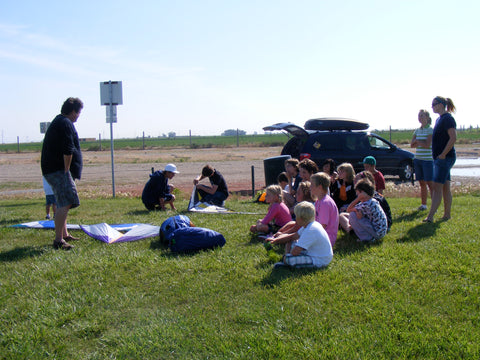
sharing kites with studentsI am often asked why in a world of drones would I still fly kites. I smile and often hand the lines to them to fly my kite and watch them discover their own answer!

I mean no disrespect to drone flyers because I think they are pretty cool. I like technology, but after careful reflection, I find that for me kites are ideal, and here are just a few reasons why:

1) Kites are low tech - what I mean is they are flown by mechanical means (i.e., lines) and not via screens or joysticks. Truth be told I have way more screen time than I need! For fear of turning into a bigger vidiot, and exacerbating the stress injury to my gaming thumbs I prefer kites!  Some of the best kites are the simple ones you can make yourself with newspaper and masking tape.

2) Kites are High Tech - in their own way - there is a lot of science and engineering in good quality kites. From high tech sail cloth to high-tech carbon frames along with geometry there is a lot that goes into a performance kite. Consider many sport kites allow you to change and interchange framing which changes the flight characteristics. Learning the tweaks for your kite can be a lot of fun and produce some pretty amazing results.

3) Crashes are not nearly as catastrophic - Parts to repair your kite are easily accessible from quality kite shops, and you can be back in the air pretty quick. Most repairs can be a successful do-it-yourself project saving time, money and adding some new crafty skills to your bag of tricks!

4) Speaking of tricks! - Have you seen the latest in slack line tricks and expressive quad line kite videos? Wow! Modern stunt kites are capable of some pretty cool maneuvres which require practice and precision. Even someone with few hours can tear up the sky with colour and motion that will attract an audience.

5) Strings attached? You bet! This is one of my favorites because it has strings Great Canadian Kite Company - Mike Roseattached - it provides multi-sensory feedback and interaction with your kite. Not only to see your kite you interact with it directly as you provide the input, and you receive feedback through the lines from the kite. In a counterintuitive way, this is a really grounded experience or maybe a better way to describe it is like a dance where you and your partner respond to each other with each step!
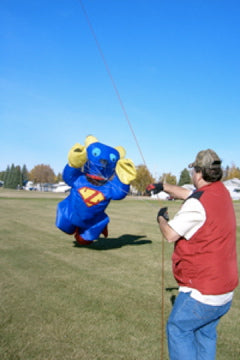
6) Colour your World - I LOVE the colour and the creativity of kites in the sky! If you have visited our Kite shop, you will have noticed the multiplicity of colours, sizes, and shapes and this makes for a dynamic hobby experience. A kite bag with a variety of kites provides a wonderful way to decorate the sky!

7) Quiet, please! - Kites, in general, are very quiet. No whining of engines, they simply ride the wind. In a world that is so darn noisy, it can be a reset to the mind to go quiet. The sound the wind in the trees, a slight whistle on the line makes for a great, stress reducing afternoon. Like a little growl? Some stunt kites make a deep rumble as the wind departs the trailing edge as they tear through the sky .

8) No Batteries required - Kites don't require batteries and as such aren't limited to 20-minute flights, and there is no need for a recharge. The Wind and the lines are all you need to fly - and wind and weather permitting... all day long!

9) There's a kite for that! - No wind? Too much wind? There's a kite for that. Remember I was talking about high-tech materials and engineering? You can get kites that you can learn to fly with no wind! Yep - zip, zero, zilch! We also have kites that are designed for higher winds too - we have a new model coming from Revolution that appears to have way less sail material than frame - like me in a bathing suit (don't picture it!) I have seen video's of this kite performing in very high winds and handling it very well!

Want a kite for water? To pull a kayak? Take pictures from? Pull you on the snow? There's a kite for that!

10) Stress buster! I'm an introvert, and as such, I spend a lot of time in my head. This can sometimes not be a good place to be! So I find going and flying a kite a great way to "get out of my head," get into the present moment and connect in a multi-tactile way with the world. The colours of the kite, actively flying my kite, giving it input to do what I want it to do and getting the feed back from the kite itself demands I stay present. I find this incredibly effective at reducing stress, and often getting a fresh perspective.

Great Canadian Kite Company - online kite storeThere are times where I will put mu earbuds in and listen to whatever kind of music I'm feeling at the moment and flying my kite to that music. It's kind of like dancing, but it allows me to express my inner state of mind through the kite. I can fly my stress out through the lines and the kite. In short order, that stress energy is replaced with a greater sense of peace and the way I fly changes. However you like to fly, I just encourage you to fly your soul, express yourself, and have fun!!

These have been just a few reasons we LOVE flying kites and why we LOVE to share kites with others!

At Great Canadian Kite Company, not only do we pride ourselves in providing a variety of quality kites for many different interests, ages and abilities, we also want to do our best to make sure your kite flying experience is great, and that means we do our best to provide a selection of kite flying tips and advice in our Kite Blog section. Browse our online Canadian kite shop to buy your kites online. We ship throughout Canada. 

Don't see what you are looking for? Have a kite related question? Drop us an email!
Read more →

Flag Pole as a Wind Meter for Kite Flying

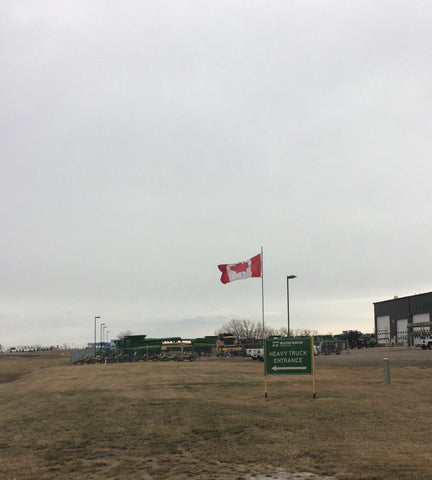
Canada flag - Taber Alberta. KitesWhen I was a young stunt kite flyer I would regularly pull out my wind metre (I have owned and lost many) and check the wind.
In the early days, I'd tweak my kite often trying to get it locked in for the wind conditions. Anyone who has flown on the prairies knows the wind is fickle and if you don't like it - no worries it will change 27 times per half hour!

While it's good to have a sense of what the wind is doing speed wise if you're gonna tweak it continually you won't get much air time. For me, I work to be aware of the wind (I'll tell ya my secret here in a minute) but I learn to adjust my flying rather than over tweaking my bridle and or frames. I will fly in the parts of the wind window that feels right and where the kite flies well.

Yes, we need to be aware of wind changes, and the dramatic changes you'll feel pretty fast but this simple trick helps me stay aware of wind direction, and changes in speed by watching flags. Whether I am flying or not I have the habit of watching flags on flag poles. I have learned by the behavior; angles and even the sound of a flag and this helps me evaluate wind conditions.


Watch a flag on a flag pole:

  • If the flag is limp with a little flutter the wind is typically less than 5 kph
  • As wind increase, the angle of the flag relative to the flag pole changes. So we can learn to estimate that angle.
  • If the flag is at a 45-degree angle then the wind speed is about 20 kph. If it is straight out, at 90 degrees you can estimate the wind at about 35-40 kph.
  • With this in mind, we can estimate the wind speed at other angles. At 22 or 75 degrees relative to the flag pole.
  • Is the flag is straight out (90 degrees relative to the flag pole) and is making a soft fluttering sound you know you are 40 - 50 kph and if the flag is making a hard, snapping sound you are upwards of 50 kph.


I'm aware that these are guess-timates at best and some may disagree with my estimations. The point is to develop your own wind sense relative to a nearby flag and flag pole and what your kite is telling you.

No flag or flag pole? I have wind feathers with streamer tails that work well too. There have been times where I have used a 1.4 inch, 4-foot piece of dowel with an eight-foot piece of surveyors tape tied to the end. I shoved it in the ground in a place where I could see it and it wasn't in the way. It worked well.

Typically, most consumer kites top out at 40 kph. When you fly them in higher than recommended wind they tend to be faster, harder to control and you risk damaging the sail, the frame or breaking the line. Good news though! There are kites that are built, designed and rated for higher winds - so not to worry. There's a kite for that!


At Great Canadian Kite Company, not only do we pride ourselves in providing a variety of quality kites for many different interests, ages and abilities, we also want to do our best to make sure your kite flying experience is great, and that means we do our best to provide a selection of kite flying tips and advice in our Kite Blog section. Browse our online Canadian kite shop to buy your kites online. We ship throughout Canada. 

Don't see what you are looking for? Have a kite related question? Drop us an email!

Read more →

Wind Window and other Kite Flying Tips

wind for kites
The wind window is an important thing to understand if you want to make your kite flying experience a blast!  Its a good idea to have an understanding of how the wind "works" and those things that affect it. Being able to determine where it is strongest and where it is lighter are key to kite performance    Obviously, as you fly your kite through the window the flight speed and characteristics can change.  With the wind at your back (yep, I really have to say it!) you will find the power zone directly in front of you.  You will find your kite is fast and pulls the hardest in this area.   

wind window for kite flying

As the kite approaches the zenith or the top of the window the kite will slow down and generate less power.

As you fly to the outer edges of the window, left and right sides, the speed and power will diminish also.

In higher wind days, I will often launch and land towards the outer edge of the window.   This allows for a slower, more controlled launch or landing.   I also tend to trick there on the higher wind days - I try and find the sweet spot where I can get enough wind at the right speed to play.

Be aware of what is up wind from you.  Trees and buildings can have a dramatic impact on the wind quality.  This is called a wind shadow.  The air moving through trees or around building can make for some trashy wind as opposed to smooth and steady.  Trashy wind buffets the sail and doesn't fill or stay filled properly and this affects flight.   Hills and valleys can also produce some interesting wind that rolls.   Personally, my favorite wind is ocean wind - smooooooth - but as a land-locked prairie boy you learn to take what you can get!

While we are talking about being aware, check for overhead power lines - flying into power lines is a recipe for a really bad day!  It can kill ya and vaporize your kite in short order.  Ben Franklin flying his kite with a key makes for a cute story but flying kites in a lightning storm is a special kind of stupid! Seriously though, please fly safe, we want kites to be a fun healthy activity for you!

Two last things.  Watch out for people.  Stunt kites and foils can get going pretty fast and sometimes people don't see or think about the lines.   Kite lines under load with speed can really hurt someone.  Be aware other others using the space.  

Last thing... DOGS.   I have had several flyers share stories of how a dog playfully attacked their kite and caused significant damage.  I know... dogs are supposed to be on a leash and the owners are responsible for them but I have yet to see a dog owner compensate a flyer for a DDK (Dog Destroyed Kite). 

 Fly safe, have fun and smooth winds!


At Great Canadian Kite Company, not only do we we pride ourselves in providing a variety of quality kites for many different interests, ages and abilities, we also want to do our best to make sure your kite flying experience is great, and that means we do our best to provide a selection of kite flying tips and advice in our Kite Blog section. Browse our online Canadian kite shop to buy your kites online. We ship throughout Canada.  

Don't see what you are looking for? Have a kite related question?  Drop us an email!

Read more →

Weather Resources for Kite Flying

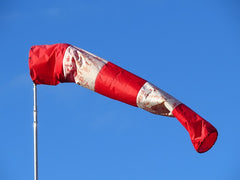
wind sock - wind for kite flyingI have found since I have started flying kites that I have a greater interest in the weather.  Aside from taking a long hard gaze at every flag pole I pass,  I have come to find a couple of online weather sources really helpful.
Environment Canada's weather site.  Find weather, wind speed and direction by city and town in Canada.  A great tool for kite flyers!

Wind Energy Atlas - a Good source of wind information! aims at developing new meteorological tools to be used by Canada's wind energy industry. Consultants and the general public will find here valuable data about this promising renewable energy."  Good source of wind information!  

Launch Code "is the premiere weather forecast source for sport aviation pilots. The forecast data is read 'real-time' from the National Weather Service Aviation web site. This data is adjusted to the local time zone and converted into a graphical format.  With over 1000 locations across the country to choose from including Hawaii and Alaska, you can probably find a Launch Code station near you."

Truth be told, despite the best weather intelligence- you just never know for sure!  Living in Southern Alberta Canada, the wind for kite flying is often feast or famine.  I compensate for this by:

a) keeping a few kites in the car.  You never know when you may have some time to fly and the weather is right!

b) I like to have some low wind, some standard and high wind kites - a kite for every wind!

So good luck!  And we sincerely wish you Smooth Winds!


At Great Canadian Kite Company, not only do we we pride ourselves in providing a variety of quality kites for many different interests, ages and abilities, we also want to do our best to make sure your kite flying experience is great, and that means we do our best to provide a selection of kite flying tips and advice in our Kite Blog section. Browse our online Canadian kite shop to buy your kites online. We ship throughout Canada.  

Don't see what you are looking for? Have a kite related question?  Drop us an email!

Read more →

What is a Wind Shadow and how it impacts Kites

What is a Wind Shadow and how it impacts Kites

Choosing an appropriate flying location for your kites is often given little thought.  For many, they look at the trees or a flag flapping in the breeze and decide to head to their local green space to fly kites. But did you know that the landscape (topography) of the flying locations has a huge impact on your kite performance?

Trees, hills, and buildings affect the quality of the wind you have in the typical flying zone and can thwart the successful launch of even some of the best kites.  On the prairies, I often describe the wind as "trashy" and by this mean it is not smooth, rather it is gusty or rolling and choppy. 

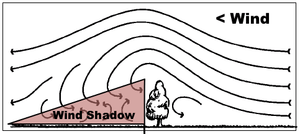
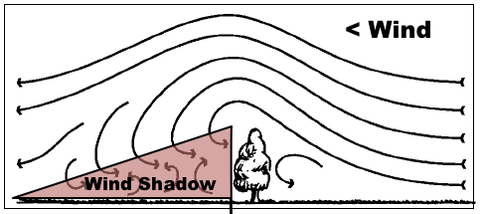
There is another term to describe this phenomenon - Wind Shadow.  Wind Shadow is the term used to describe the disturbed airflow downwind of obstructions like trees, hills, and buildings.  

Think of it this way; have you ever stood behind a tree or a building to escape a cold wind?   The obstacle blocks the wind forcing the airflow to go around, under or over the obstacle. It is this air movement that creates disturbed (flakey, choppy, trashy) air flow.  This wind is often swirling and rotating which can sometimes create downdrafts that can keep your kite from taking flight.


Learn more: Understanding the Wind Window


Flying field selection is key and this means being aware of what's around you.  The rule of thumb is a wind shadow is approximately 7 times the height of the obstacle.  So, if a building is 20ft tall, it is a good idea to launch your kite 140ft downwind of the building.


Wind shadow affect on kites

Careful flying field selection and paying attention to recommended kite wind ranges becomes even more important when we fly performance stunt kites - where we are looking for smooth steady airflow. It becomes a significant safety consideration when flying large traction kites.  Being aware of the impact of the Wind Shadow can go a long way to making your kite flying successful!

At Great Canadian Kite Company, not only do we we pride ourselves in providing a variety of quality kites for many different interests, ages and abilities, we also want to do our best to make sure your kite flying experience is great, and that means we do our best to provide a selection of kite flying tips and advice in our Kite Resources section. Browse our online Canadian kite shop to buy your kites online. We ship throughout Canada.  

Don't see what you are looking for? Have a kite related question?  
Drop us an email!

Read more →

Join the American Kitefliers Association (AKA)

THE AKA IS A NONPROFIT ORGANIZATION DEDICATED TO SHARING KITE FLYING WITH THE WORLD.

American Kite Fliers AssociationFounded in 1964 by the late Robert M. Ingraham of New Mexico, the American Kitefliers Association (AKA) has thousands of members in 25 countries, making it the largest association of kite fliers and kite clubs in the world. Our purpose is to educate the public in the art, history, technology, and practice of building and flying kites - to advance the joys and values of kiting in all nations.

We strive to promote public awareness of the pleasures and educational opportunities that kites provide. They can remind us about how we interact with our environment and each other. Kites can be a source of community building, breaking down barriers that typically prevent us from interacting. No words are needed to fly a kite!

Learn More about the AKA

Read more →

Assembling Your HQ Butterfly Kite

My boys set to work to produce this informative video on how to set up the HQ Butterfly kite.  These beauties are pretty simple to assemble and these few tips will help you avoid a few common assemble mistakes!

Read more →

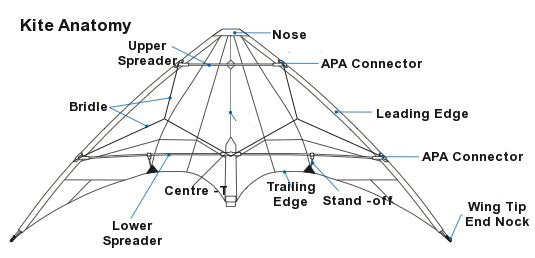
Anatomy of a Stunt Kite

This is a basic diagram of the parts of a dual line stunt kite.  This is helpful when trying to figure out what replacement part you require! 

Parts of a stunt kite, trick kite

Read more →

What is a Parafoil kite?

What is a Parafoil kite?

Parafoil kites are typically crafted from ripstop nylon without a stiff frame or skeleton. Imagine it as resembling a parachute. The clever design of the parafoil kite is credited to Domina Jalbert (1904-1991).

The parafoil kite has an upper and lower skin (hence para) with vertical fabric cells sewn in between the two skins.  These cells fill with air and give shape and form to the kite so that it can take flight.  Through the opening of the cells in leading edge (top) of the kite wind is tunnelled into the cells.   The resulting air pressure is what give the parafoil kite its aerodynamic shape allowing it to take flight.

The parafoil kite uses an intricate bridling system that is designed to add further shape and aerodynamics to the foil helping it to have an efficient angle of attack for the wind in relation to the tow point where the flying line(s) connect.  Efficient and effective bridling of the kite also adds stability and in some applications like kite surfing makes for stable efficient maneuverability.

Usually the bridling is ideal out of the bag but sometimes experienced kite flyers will adjust the bridle for various wind conditions.

Parafoils come in a number of shapes and sizes.  These include single line kites to large lifting parasols, to multi-line traction kites designed to generate pull and power for snow kiting and kite surfing.  The same theory is used with many large inflatable show kites that you may have seen.

The benefits of the Parafoil kite includes no framing to break or lose, they are pretty easy to fly, can generate strong pull.  In addition, they pack up into a relatively small package which makes transport and storage pretty easy!

Great Canadian Kite Company sells a variety of parafoil kite designs from the simple single line kite to the big lifters to the parafoil kites used for snow kiting and KiteSurfing. Browse our online Canadian kite shop to buy your kites online.  Don't see what you are looking for?  Drop us an email!

Read more →

Glossary of Kite Terms

mike at Great Canadian Kite CompanyThere are a variety of terms that are used in the sport of Kite flying.  Here is a short list to give you some common lingo and their meaning!

Bridle:  the lines which connect to the kite sail and frame to help support the kite and/or to orient the kite at a proper angle to the wind.

Carbon / Graphite:  Stunt kite frames are made of carbon fiber which is relatively are rigid  material and light weight.    Can be in a rod or tube form.  Popular graphite products include: Sky Shark, Icone and Revolution. Wrapped or extruded.

Centre T:  Where the spar for the spine and lower spreaders are joined.

Dark Side (The): An affectionate term for those Kite enthusiast who have embraced flying the quad-line stunt kite by Revolution Kites.

Dual Line: Refers to two line trick or stunt kites. The two lines allow for the control of the kite. (There are Quad line stunt kites as well)

Dyneema kite line: A brand of synthetic fiber used in making performance kite line. It's best advantage is it's very strong and yet very thing and doesn’t stretch much.  Not all spectra lines are created equal!  Spectra fibre is used to make popular premium flying line.  These brands may incorporate unique braiding of the fibre, coating with agents to reduce friction and sometime to make them resistant to UV and salt water.  All of which enhance performance and line life significantly.

Fiberglass: This is a kite material which combines strength and flexibility with relative light weight. It comes in several forms from solid fiberglass rods and hollow tubes.

Flying Straps: A loop made of webbing that attaches to your kite line.  You then slide you hands into the loops to hold the kite while you fly. These are ideal for performing the modern slack line kite tricks. See them here

Frame: The skeleton of the kite.

Freestyle: "Freestyle" kite is typically a good performer, capable of a wide range of tricks while still very stable and predictable. Freestyle is performing a variety tricks of one after another in succession.

Foil Kite:  Foil kites look like a parachute and use the wind itself to give structure to the kite.  These kites can be two, three and four line kites  in a wide variety of sizes.  These kites can genrate a great deal of power.  Obvoiusly the larger the kite the more power / pull with the same wind speed.  You will see smaller recreation ones to the very large which pull the pilot in a buggy, a snowboard or kite surf board.

Ground Stake: A handy tool which allows you to stake your kite handles or flying straps to the ground while you walk to reset or adjust your kite for launch.  This tool helps to ensure your kite doesn’t blow away.

Icarex:  A brand name of a type of ripstop fabric made from polyester fibers. It is lighter and more fade resistant than nylon ripstop fabric. 

Kite Party: Informal gatherings of kite flyers, who meet to fly kites, socialize with other kite flyers  and get their Kite on!

Leading edge:  The name for the part of the kite which runs from the nose to the wing tip.

Line Set: The lines which are used to control the kite. They come in a variety of test weight and lengths. Stronger weight lines being used for stronger winds and bigger kites.  Line sets are made of a variety of fibres.

Quad Handles:  Handles made specifically to fly quad line kites like those made by Revolution.  Lines from the top and bottom of the kite are attached correspondingly to the top and bottom of the flying handles which changes the shape of the wing and creates flight. See Them here

Quad line: Kites with four lines for control. Not only can you maneuver left and right, but you can fly sideways, spin like an airplane propeller, and forward or backward in the wind window.

Ready to Fly / RTF:  Many kites are sold with everything you need to get started.  Ready to fly means all you have to do is assemble the kite, attach the included line and add wind!  Many high end kites are sold as Kite only.

Rip-stop:  Typically used to make kite sails.  It can be made of nylon or polyester.  Hence ripstop nylon or ripstop polyester. Rip-stop is the process that weaves smaller fibers with larger fibers creating squares of reinforcing fibers in the cloth which make it resistant to tearing. The idea being that a tear will stop at one of the reinforcing fibers.

Sail: The cloth material of the kite. The material is usually made from rip-stop nylon, polyester, Icarex.

SkyShark: Is a brand of high quality performance carbon fibre tubing used to frame performance kites. Made in the USA.

Sleeving: A cover which encloses the ends of flying lines and helps to preserve strength and prevent wear.  Typically where the line sets are tied.

Soul Flying:  This is term referring to a style of stunt kite flying where you express yourself freely with your kite - Whether to music or to silence, precision or full on tricks you are in effect flying your Heart via your kite!

Spar: A generic term referring to the framing material used as the frame of a kite.

Spectra®:  A brand of synthetic fiber used in making performance kite line. It's best advantage is it's very strong and yet very thing and doesn’t stretch much.  Not all spectra lines are created equal!  Spectra fibre is used to make popular premium flying line.  These brands may incorporate unique braiding of the fibre, coating with agents to reduce friction and sometime to make them resistant to UV and salt water.  All of which enhance performance and line life significantly.

Spine: The center rod that runs lengthwise down a kite.

Spreader: The spars which run horizontally across the span of the kite holding the wings open. 

Stand-offs:  Are typically carbon or fibreglass rod which holds the trailing edge of the sail back from the lower spreader.  You may be able to fine-tune the performance of your kite in different wind conditions as their position affects the amount of lift the kite generates and thereby it's speed, turning, and precision.

Tail: Attached to the kite for visual effect or to cause drag on a single line kite.  Made of Ripstop or plastic.  Also a term to describe the lower end of the spine.

Tow point: The part of the bridle where the flying lines are attached using a Larkshead knot.

Winders:  For ease of use, lines are stored on winders.  With line(s) together, wrap the lines around the winder fairly snuggly. Some flyer prefer wrapping the lines in a figure eight motion, others prefer a simple wrap.  With care, either will work just as well.

Wind range: The range of wind speed that a kite will fly well in. Can be given in Kph, mph, or beaufort .

Wind window: 
 A 180 degrees in which the kite flies.  It’s size is determined by the length of the flying lines. At the edges of the window the kite will slow and has a tendency to stall and makes for a great place to land.

Read more →