
Skip to content Skip to side menu

Tied to the Sky

Why do we Sleeve Spectra Kite Lines?

Why do we Sleeve Spectra Kite Lines?

kite line sleeving kitKite line Sleeving 


(You can find this article in our Kite Resources section too!)

Line sets
 are an important and costly necessity of flying your multiline sport kite, so it is important to make sure that you take steps to protect your line sets to maintain performance, increase longevity of the line and save you money.

Sleeving is like a tube sock that we put on the ends of spectra kite lines or any place where we tie a knot. Sleeving is made of hollow braided Dacron and is usually positioned at either end of each line where the line connects via a Larkshead Knot to the flying straps or to the kite tow point.

Spectra kite line, while stronger than steel, has a relatively low melting point.  Wherever there is a knot in the line this is a place of friction which creates heat and will significantly reduce the strength of your spectra line and will be the point of a line break.

This sleeving material acts like a heat diffuser by reducing and diffusing the heat generated by friction at the knot.


Sleeving Your lines.

At Great Canadian Kite Company, all of the sport kite spectra line sets we sell comes pre-sleeved. We are pleased to offer a variety of quality kite line that provides good braid braid, performance and kite line life. That being said it is possible to purchase line sets that are not sleeved, or perhaps you wish to buy bulk kite line and make your own line sets and then a kite line sleeving kit is a valuable tool.


To make your own line sets you will first want to stretch your lines and make them equal length.  With cheaper line (even cheaper spectra labeled line) you can expect lines to stretch as much as 12-15% where quality line sets may stretch 4-6%.   The point is line will stretch with use and it may be necessary to equalize your lines from time to time.

Once your lines are stretched and measured you are ready to sleeve each end. Our Sleeving kits come with simple instruction, two different colours of sleeving and a sleeving tool.  Here are the basic steps to sleeving your spectra kite line:

  • Sleeve one end of the line at a time making sure that you use the same colour of sleeving for both ends of the same line.  This is really helpful to help you keep straight which line goes to each side of the kite and which its corresponding flying strap.
  • Insert the sleeving tool through the sleeving. Pull the tool a few centimetres through the sleeving.
  • After the tool is inserted through the sleeve carefully take a lighter and melt the ends of the dacron for a clean looking sleeving job. This will keep the sleeving from fraying.
  • Thread your Spectra line through the end of the sleeving tool and pull the tool back through the dacron sleeving bringing the kite line with it.
  • With the sleeving now on your line, you can remove the sleeving tool.
  • Slide the sleeving towards the end of the line being careful not to go too far or you will have to reinstall the sleeve using the sleeving tool.
  • Tie a knot in the very end of the line (including the sleeve).
  • Stretch the sleeving back up the line so it won't bunched up.
  • Tie another knot at the end farthest from the end.
  • Bring these two knots together and make a loop as shown below. Make sure this loop is big enough that you can easily tie a Larkshead knot to attach to the kite or flying straps.  Ensure these loops are the same size on each end of each line.

The end of the line is now sleeved and you can repeat the process for each of the other lines.  Remember: make sure you have the same colour sleeving on the ends of the same line. 

Sleeving kite line

Read more →

Kites: Not Just Another SKu

Kites: Not Just Another SKu

Great Canadian Kite CompanyThere is an old joke in the kite retail biz that goes:  How do you make a million dollars selling kites?  Answer:  Start with two million dollars!
It usually produces a chuckle, if not through a few tears!

The kite business has been good to us as we reflect over our past 20 years providing great kites and service to kite flyers throughout Canada and beyond.  It has been a joy to help people discover kites, and help them develop a fun family and personal hobby.

We are excited because right from the beginning the mission of the Great Canadian Kite Company was to promote the sport of Kites and share the fun.  We have endeavoured to do so by providing top-shelf knowledgeable service along with quality products at fair and competitive prices.

In addition, we have supported Kite Festivals, hosted numerous fun-flies, sponsored and supplied kites and information for kite exhibits in local libraries and schools, teaching people to fly, as well as being friendly on the kite field with onlookers, and the interested.  Its one thing for folks to look on, its quite another when you put the lines in their hands!

If you haven't guessed, we like kites - a lot.  We are proud of our kite shop.  We are a kite shop owned by everyday people who enjoy kites.   As such, kites are not just another Sku., not just another do-dad that we sell.   Kites are our thing!

While we work really hard to compete with larger online retailers, we offer something they simply can't - a professional, personalized kite purchase experience.   We know kites. We work hard to resource our customers with solid information to help in making a good purchase but also to be able to help trouble shoot when there may be a performance concern or you need parts to get your kite back in the air.

We pride ourselves on providing solid service both before and after the sale. And as our many repeat customers, referrals, and many 'Thank you' emails demonstrate, we are definitely doing some things right!

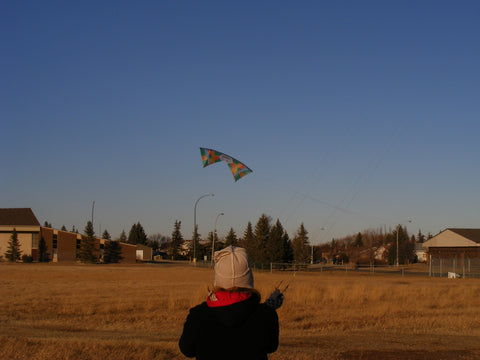
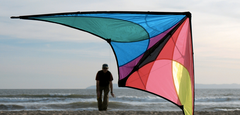
We can't be all things to all people, all the time, but for Great Canadian Kite Company, kites are not just another Sku. Kites are our main thing.  Our commitment is to do our very best to do that one thing really well.


Read more →

Wind Ranges for Kites - What to think!

Wind Ranges for Kites - What to think!

Andrea of Great Canadian Kite Company flying her Revolution kite

I remember as a kid trying to fly kites that you had to run like mad just to keep them aloft. It made for a very frustrating experience. One exception from my childhood was a delta shaped black plastic kite  - the one that you affixed adhesive eyes too. These fiery eyes made it look pretty cool, and you know, it flew pretty well! As fun as that kite was, being made of plastic it didn't last very long!

When we started the Great Canadian Kite Company (read our story here) we wanted to make sure that we sold a quality product that flew well and was built to be durable by quality kite standards. As such, the kites we have chosen are from reputable manufacturers with proven designs that fly in the stated conditions.

But even then... what does a wind range really mean? A wind range is provided to communicate the range of wind speed that the kite will fly in. So a range of 10 - 40 kph means that the kite is capable of flying in winds as low as 10 Kph to an upper limit of 40 kph.

The upper range can be a little more flexible if just flying the kite is the priority. When kites fly in winds above the range, they will often become much faster, harder to control, pull too hard and become difficult to trick. Too much wind will rip stitches and fabric, or break framing and line. It also can increase the potential for damage with hard crashes.

In higher winds you can add wind brakes or add tails, and this will often raise the upper limit.

Nexus Kite by Prism KitesSometimes, especially with stunt kites (low wind or Indoor) you see a lower wind range of zero or 5 or 8 or 10 kph. Low wind kite flying is an art as much as it is a science, and many manufacturers when establishing the lower end of the wind range have folks testing it who are really good pilots!

So can the kites fly at those low ranges? You bet! Can anybody fly them in the low range - with some practice you can learn to keep your kite aloft at the lowest wind ranges.

As kite professionals, we are here to offer you experienced recommendation on the kinds of kites and kite accessories that will get you in the air with the goal of providing the best kite flying experience we can!

Great Canadian Kite Company also have some Resources for the Kite Flyer:

Read more →

Flying Kites for the Health of it!

Flying Kites for the Health of it!

Health Fitness Revolution shared Top Ten Benefits of Kite-Flying on their site  in April of 2015. There are other articles along the same line but Health Fitness Revolution put together  a pretty impressive list. Here are their Top 10 Health Benefits of Kite-Flying:

Read more →

Flag Pole as a Wind Meter for Kite Flying

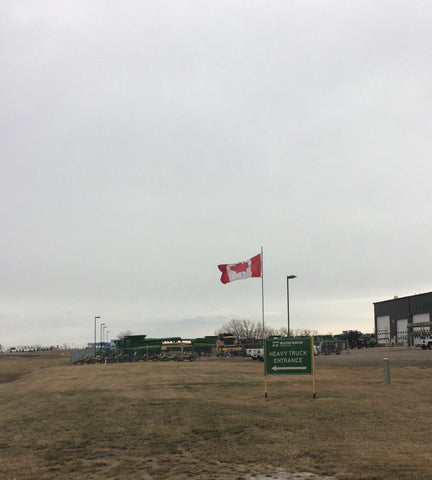
Canada flag - Taber Alberta. KitesWhen I was a young stunt kite flyer I would regularly pull out my wind metre (I have owned and lost many) and check the wind.
In the early days, I'd tweak my kite often trying to get it locked in for the wind conditions. Anyone who has flown on the prairies knows the wind is fickle and if you don't like it - no worries it will change 27 times per half hour!

While it's good to have a sense of what the wind is doing speed wise if you're gonna tweak it continually you won't get much air time. For me, I work to be aware of the wind (I'll tell ya my secret here in a minute) but I learn to adjust my flying rather than over tweaking my bridle and or frames. I will fly in the parts of the wind window that feels right and where the kite flies well.

Yes, we need to be aware of wind changes, and the dramatic changes you'll feel pretty fast but this simple trick helps me stay aware of wind direction, and changes in speed by watching flags. Whether I am flying or not I have the habit of watching flags on flag poles. I have learned by the behavior; angles and even the sound of a flag and this helps me evaluate wind conditions.


Watch a flag on a flag pole:

  • If the flag is limp with a little flutter the wind is typically less than 5 kph
  • As wind increase, the angle of the flag relative to the flag pole changes. So we can learn to estimate that angle.
  • If the flag is at a 45-degree angle then the wind speed is about 20 kph. If it is straight out, at 90 degrees you can estimate the wind at about 35-40 kph.
  • With this in mind, we can estimate the wind speed at other angles. At 22 or 75 degrees relative to the flag pole.
  • Is the flag is straight out (90 degrees relative to the flag pole) and is making a soft fluttering sound you know you are 40 - 50 kph and if the flag is making a hard, snapping sound you are upwards of 50 kph.


I'm aware that these are guess-timates at best and some may disagree with my estimations. The point is to develop your own wind sense relative to a nearby flag and flag pole and what your kite is telling you.

No flag or flag pole? I have wind feathers with streamer tails that work well too. There have been times where I have used a 1.4 inch, 4-foot piece of dowel with an eight-foot piece of surveyors tape tied to the end. I shoved it in the ground in a place where I could see it and it wasn't in the way. It worked well.

Typically, most consumer kites top out at 40 kph. When you fly them in higher than recommended wind they tend to be faster, harder to control and you risk damaging the sail, the frame or breaking the line. Good news though! There are kites that are built, designed and rated for higher winds - so not to worry. There's a kite for that!


At Great Canadian Kite Company, not only do we pride ourselves in providing a variety of quality kites for many different interests, ages and abilities, we also want to do our best to make sure your kite flying experience is great, and that means we do our best to provide a selection of kite flying tips and advice in our Kite Blog section. Browse our online Canadian kite shop to buy your kites online. We ship throughout Canada. 

Don't see what you are looking for? Have a kite related question? Drop us an email!

Read more →

What is a Wind Shadow and how it impacts Kites

What is a Wind Shadow and how it impacts Kites

Choosing an appropriate flying location for your kites is often given little thought.  For many, they look at the trees or a flag flapping in the breeze and decide to head to their local green space to fly kites. But did you know that the landscape (topography) of the flying locations has a huge impact on your kite performance?

Trees, hills, and buildings affect the quality of the wind you have in the typical flying zone and can thwart the successful launch of even some of the best kites.  On the prairies, I often describe the wind as "trashy" and by this mean it is not smooth, rather it is gusty or rolling and choppy. 

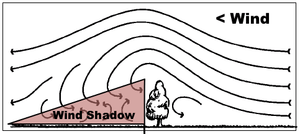
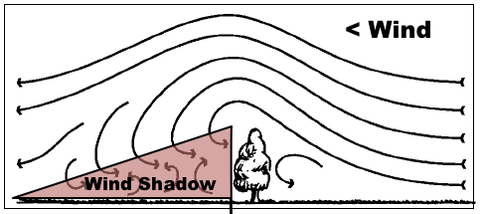
There is another term to describe this phenomenon - Wind Shadow.  Wind Shadow is the term used to describe the disturbed airflow downwind of obstructions like trees, hills, and buildings.  

Think of it this way; have you ever stood behind a tree or a building to escape a cold wind?   The obstacle blocks the wind forcing the airflow to go around, under or over the obstacle. It is this air movement that creates disturbed (flakey, choppy, trashy) air flow.  This wind is often swirling and rotating which can sometimes create downdrafts that can keep your kite from taking flight.


Learn more: Understanding the Wind Window


Flying field selection is key and this means being aware of what's around you.  The rule of thumb is a wind shadow is approximately 7 times the height of the obstacle.  So, if a building is 20ft tall, it is a good idea to launch your kite 140ft downwind of the building.


Wind shadow affect on kites

Careful flying field selection and paying attention to recommended kite wind ranges becomes even more important when we fly performance stunt kites - where we are looking for smooth steady airflow. It becomes a significant safety consideration when flying large traction kites.  Being aware of the impact of the Wind Shadow can go a long way to making your kite flying successful!

At Great Canadian Kite Company, not only do we we pride ourselves in providing a variety of quality kites for many different interests, ages and abilities, we also want to do our best to make sure your kite flying experience is great, and that means we do our best to provide a selection of kite flying tips and advice in our Kite Resources section. Browse our online Canadian kite shop to buy your kites online. We ship throughout Canada.  

Don't see what you are looking for? Have a kite related question?  
Drop us an email!

Read more →

Assembling Your HQ Butterfly Kite

My boys set to work to produce this informative video on how to set up the HQ Butterfly kite.  These beauties are pretty simple to assemble and these few tips will help you avoid a few common assemble mistakes!

Read more →

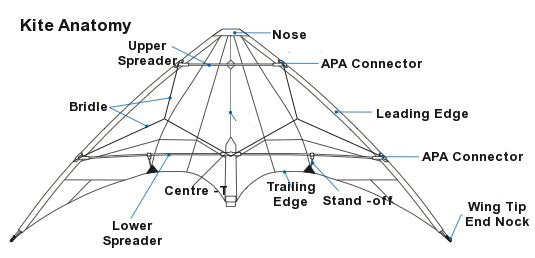
Anatomy of a Stunt Kite

This is a basic diagram of the parts of a dual line stunt kite.  This is helpful when trying to figure out what replacement part you require! 

Parts of a stunt kite, trick kite

Read more →

What is a Parafoil kite?

What is a Parafoil kite?

Parafoil kites are typically crafted from ripstop nylon without a stiff frame or skeleton. Imagine it as resembling a parachute. The clever design of the parafoil kite is credited to Domina Jalbert (1904-1991).

The parafoil kite has an upper and lower skin (hence para) with vertical fabric cells sewn in between the two skins.  These cells fill with air and give shape and form to the kite so that it can take flight.  Through the opening of the cells in leading edge (top) of the kite wind is tunnelled into the cells.   The resulting air pressure is what give the parafoil kite its aerodynamic shape allowing it to take flight.

The parafoil kite uses an intricate bridling system that is designed to add further shape and aerodynamics to the foil helping it to have an efficient angle of attack for the wind in relation to the tow point where the flying line(s) connect.  Efficient and effective bridling of the kite also adds stability and in some applications like kite surfing makes for stable efficient maneuverability.

Usually the bridling is ideal out of the bag but sometimes experienced kite flyers will adjust the bridle for various wind conditions.

Parafoils come in a number of shapes and sizes.  These include single line kites to large lifting parasols, to multi-line traction kites designed to generate pull and power for snow kiting and kite surfing.  The same theory is used with many large inflatable show kites that you may have seen.

The benefits of the Parafoil kite includes no framing to break or lose, they are pretty easy to fly, can generate strong pull.  In addition, they pack up into a relatively small package which makes transport and storage pretty easy!

Great Canadian Kite Company sells a variety of parafoil kite designs from the simple single line kite to the big lifters to the parafoil kites used for snow kiting and KiteSurfing. Browse our online Canadian kite shop to buy your kites online.  Don't see what you are looking for?  Drop us an email!

Read more →

Kites for Father's Day - June 19

Father's day, kites, gift

Father's Day is just around the corner, but it's not too late to get the special dad in your life a gift that will thrill!. Kites are a fantastic way to get some fresh air, fly stress away and have fun! Whether he is tearing up the sky with a Stunt Kite or chillin' with a Single Line Kite dancing on the wind, are great fun for the whole family!

We have a wide selection  of quality made, great flying single line kites for almost any taste!.  Easy to fly kites in a variety of shapes, sizes and designs make single line kites a great choice for family fun and relaxation!

Our Stunt kites will Thrill!!  Stunt kites allow the flyer to become a pilot as they take control of the kite lines; fly loops and spins, and with practice, you can learn some jaw-dropping kite tricks.  Stunt kites are a great way to relax and enjoy the outdoors.

Great Canadian Kite Company is your full service Kite Shop serving Canada and Great Canadian Kite Companybeyond from Alberta.  Check out our selection of quality kites in our online kite shop.  Quality Kites, selection and top notch service and support before AND after your kite purchase!

Read more →